29.1.12


A PARTICULAR KIND OF HEAVEN
Ed Ruscha


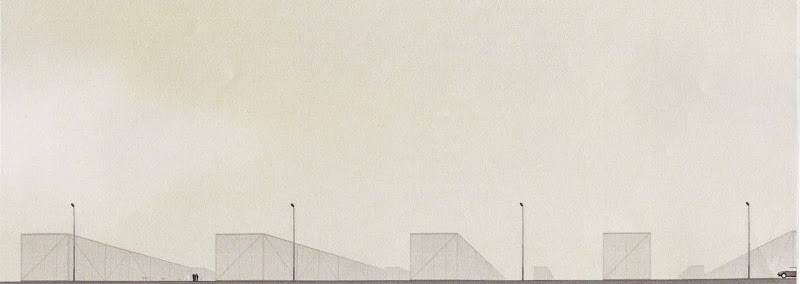
As noticed in SOCKS today, the Mendrizio students' works from our the last post looks a bit like Ed Ruscha' s architectural landscapes. See below.


23.1.12


ARCHITECTURE WITHOUT CONTENTS
Mendrizio


Selected works from Architecture Without Contents' studio at Mendrizio

Students : O.A. Alexandru, K.Nilsen, L.Silva, N. Do Amaral, R.Roncoroni, L. Vinti, F. Piantoni, B.Orlandi
Teachers : Office KDGVS, C. Daldoss, A. Zanderigo
Autumn/winter 2011


19.1.12


DEMOCRATIC FOREST
William Eggleston


Holmes n’était certes pas difficile à vivre! C’était un homme tranquille aux habitudes bien ancrées. Il était rarement debout après 22 heures et prenait son pétit déjeuner et sortait bien avant mon réveil. Tantot il passait la journée au laboratoire de chimie, tantôt dans les salles de dissection, et de temps à autre, une de ses longues marches le conduisait dans les bas quartiers. Il déployait une energie à toute épreuve dans ses accès de travail puis venait la réaction : pendant de longues journées, il restait étendu sur le canapé sans dire un mot, sans bouger un muscle du matin au soir. En ces occasions, j’ai remarqué que son regard devenait si reveur et si vague que j’aurai pu le soupconner de s’adonner à quelconque narcotique, si sa sobriété et sa tempérance habituelle n’interdisaient telle supposition. Son ardeur pour diverses études était remarquable. Il avait pour l’insolite des notions si formidablement étendues et détaillées que ces observations m’ébaudissaient considérablement. Nul homme n’aurait tant travaillé à la collecte de tant de précisions sans s’être fixé un but défini.
Les touche-à-tout se démarquent rarement par l’exactitude de leur savoir. Nul ne s’embarasse l’esprit du superflu s’il n’a une très bonne raison pour le faire. Ses ignorances étaient aussi remarquable que sa science. De la litterature contemporaine, de la philosophie et de la politique, il ne semblait savoir à peu près rien. Un jour que je citais Thomas Carlyle, il me demanda très naivement qui il était et ce qu’il avait fait. Ma surprise atteignait son paroxysme quand incidemment je découvris qu’il ignorait la théorie de Copernic et tout du systeme solaire. Qu’un être civilisé, au 19e siècle, ne sut pas que la terre tourne autour du soleil, me semblait un fait si extraordinaire que j’avais peine à y croire.
«Vous paraissez étonné» dit-il en souriant de ma surprise. «Maintenant que je sais cela, je tacherai de l’oublier»
«Mais le système solaire!» fis-je.
«Que voulez-vous que cela me fasse?» coupa-t-il avec impatience. «Nous tournons autour du soleil, dites-vous?. Si c’était la lune cela ne ferait pas deux sous de différence pour moi ou mes travaux!»

I was in Oxford, Mississippi for a few days and I was driving out to Holly Springs on a back road, stopping here and there. It was the time of year when the landscape wasn’t yet green. I left the car and walked into the dead leaves off the road. It was one of those occasions when there was no picture there. It seemed like nothing, but of course there was something for someone out there. I started forcing myself to take pictures of the earth, where it had been eroded thirty or forty feet from the road. There were a few weeds. I began to realize that soon I was taking some pretty good pictures, so I went further into the woods and up a little hill, and got well into an entire roll of film.

Later, when I was having dinner with some friends, writers from around Oxford, or maybe at the bar of the Holiday Inn, someone said, ‘What have you been photographing here today, Eggleston?’
‘Well, I’ve been photographing democratically,’ I replied.
‘But what have you been taking pictures of?’
‘I’ve been outdoors, nowhere, in nothing.’
‘What do you mean?’
‘Well, just woods and dirt, a little asphalt here and there.’
I was treating things democratically, which of course didn’t mean a thing to the people I was talking to. I already had different, massive series. I had been to Berlin and to Pittsburgh and completed huge bodies of work. From that moment everything from the boxes of thousands of prints made cohesive sense for the first time. All the work from this period from 1983 to 1986 was unified by the democracy. Friends would ask what I was doing and I would tell them that I was working on a project with several thousand prints. They would laugh but I would be dead serious. At least I had found a friend in that title, The Democratic Forest, that would look over me.


Premier texte, inconnu
Deuxième texte, William Eggleston "Afterwords on Democratic Forest"
Aujourd'hui est un jour triste pour la photographie, Kodak a annoncée officiellement sa faillite
Si ca vous dit d'en savoir plus sur William Eggleston, un des premiers maitres de la couleur en photo, et par conséquent un des premiers explorateurs du monde des films couleurs Kodak, il y a cet excellent documentaire By the Ways et évidemment le Eggleston's channel d'American Suburb X

31.12.11


LA GRILLE
Félix Guattari & Diane Arbus


A la clinique de La Borde, en Lozère, Félix Guatari associé au directeur le Docteur Jean Oury, mettent en place un système de responsabilisation des malades et du personnel à travers une grille. Chacun d’entre eux, assignés normalement à un rôle particulier, est contraint de s’investir dans des tâches qui lui sont étrangères. Ainsi que ce soit les medecins, les infirmiers, les employés de ménages, les cuisiniers, les malades.. Ils se voient impliqués (à des degrés de responsabilités différent ) dans la vie de la clinique, et cela à toute heure.

Cadrer le dérèglement

En ce qui me concerne, Je me suis totalement investi dans cette expérience à partir de 1955 ; bien que j’ y aie participé de façon assez suivie dès la phase préparatoire de Saumery. Et c’est durant cette période-là que se sont posés les grands problèmes qui devaient marquer l’évolution ultérieure. Assez rapidement, la clinique a augmenté sa capacité ; elle est passée à soixante malades, puis quelques années plus tard à sa capacité actuelle. Corrélativement, le personnel a augmenté et les anciennes méthodes d’organisation consensuelle, fusionnelle, ne pouvaient évidemment plus fonctionner de la même façon. Quand je suis arrivé, j’ai commencé à m’occuper des activités d’animation et des ateliers. J’ai contribué à la mise en place de pas mal des institutions qui devaient se maintenir de façon durable—quoique toujours en évolution. Mais, assez rapidement, j’ai été amené à m’occuper des problèmes de gestion. Durant les années antérieures, s’étaient instituées des différences de salaires assez marquées, pour des raisons, d’ailleurs, plutôt contingentes, en raison d’arrangements qui se faisaient au fur et à mesure de l’arrivée des nouveaux membres du personnel. Tout ça pour dire qu’il y avait une situation assez floue, assez peu maîtrisée. Une des premières difficultés à laquelle je me suis trouvé confronté a été relative au budget des ateliers, lorsqu’ils furent instaurés de façon plus systématique, avec la mise en place du Club ; l’administratrice de cette époque refusait systématiquement de les aider financièrement et il a fallu que je me substitue a elle. À côté de cela, Oury se méfiait beaucoup de quelque chose qui existait dans la plupart des établissements publics, à savoir l’existence d’ergothérapeutes ou de sociothérapeutes spécialisés qui fonctionnaient de façon autonome par rapport au reste du personnel et qui devaient d’ailleurs acquérir ultérieurement une qualification particulière. Ça ne nous paraissait pas souhaitable, parce qu’au contraire on voulait à tout prix éviter que les activités ne deviennent stéréotypées, refermées sur elles-mêmes. Pour nous, le but n’était pas de parvenir à stabiliser une activité particulière. Son fonctionnement ne nous intéressait que pour autant qu’il permettait d’enrichir les rapports sociaux, de promouvoir un certain type de responsabilisation, aussi bien chez les pensionnaires que dans le personnel. Donc, nous n’étions pas trop favorables à l’implantation d’ateliers standardisés (vannerie, poterie, etc.) avec le ronron du responsable qui vient faire son petit boulot à longueur d’année et avec des pensionnaires qui viennent là régulièrement, mais de façon un peu mécanique. Notre objectif de thérapie institutionnelle n’était pas de produire des objets ni même de produire de « la relation » pour elle-même, mais de développer de nouvelles formes de subjectivité. Alors, à partir de là, toutes sortes de problèmes se posent sous un angle différent : on s’aperçoit que pour faire des ateliers, pour développer des activités, le plus important n’est pas la qualification du personnel soignant (diplôme d’infirmier, de psychologue, etc.), mais les compétences de gens qui peuvent avoir travaillé dans le domaine agricole ou comme lingère, cuisinier, etc. Or, bien entendu, pour pouvoir suffisamment dégager ces personnes de leur service, de leur fonction et pour pouvoir les affecter au travail des ateliers et des activités rattachées au Club, il est nécessaire d’inventer de nouvelles solutions organisationnelles, parce que sinon ça déséquilibrerait les services. En fait, ça n’allait de soi d’aucun point de vue, ni dans la tête du personnel soignant, ni dans celles des personnes directement concernées. Il a donc fallu instituer un système, qu’on pourrait dire de dérèglement de l’ordre « normal » des choses, le système dit de « la grille », qui consiste à confectionner un organigramme évolutif où chacun a sa place en fonction 1) de tâches régulières, 2) de tâches occasionnelles, 3) de « roulements », c’est-à-dire de de tâches collectives qu’on ne veut pas spécialiser sur une catégorie particulière de personnel (exemple : les roulements de nuit, les roulements qui consistent à venir à 5 h du matin, la vaisselle, etc.). La grille est donc un tableau à double entrée permettant de gérer collectivement les affectations individuelles par rapport aux tâches. C’est une sorte d’instrument de réglage du nécessaire dérèglement institutionnel, afin qu’il soit rendu possible, et, cela étant, pour qu’il soit « cadré » (...)

Affects et affectations

(...) La grille est alors un instrument indispensable pour instaurer un rapport analytique entre les différentes instances institutionnelles et les affects individuels et collectifs. Affects et affectations : la grille, c’est quelque chose qui est chargée d’articuler ces deux dimensions. Dans une perspective idéale ! Car dans les faits, c’est un problème complexe parce que, dès lors que vous renoncez à la rigidité des organigrammes technocratiques, vous vous heurtez à une multitude de difficultés ; les choses en apparence les plus simples se compliquent. Ce qu’on peut répondre aux technocrates, c’est qu’avec quelques notes de musique on peut aussi bien faire une musique très simple, par exemple une musique modale, qu’une musique infiniment riche. Il faut pour cela changer les gammes de référence, faire de la polyphonie… Avec une institution c’est pareil. On peut faire du plain-chant où chacun reste assujetti à une ligne monadique. On peut, au contraire, développer des compositions baroques d’une grande richesse. On s’est aperçu qu’avec une population de cent pensionnaires et quatre-vingt membres du personnel, on pourrait faire des choses d’une complexité incroyable. Pas pour le plaisir de la sophistication, mais parce que c’est nécessaire pour produire un autre type de subjectivité. On peut aussi concevoir des systèmes d’un type beaucoup plus monacal, où chacun trouve sa place au rythme des heures canoniales. Mais il faut admettre qu’il peut être nécessaire de composer des musiques institutionnelles polyphoniques et symphoniques si on veut essayer de saisir de façon plus fine les problèmes subjectifs inconscients relatifs au monde de la psychose.

Singulariser les trajectoires dans l'institution

Cela m’amène à une réflexion plus générale sur les finalités de la grille. Quelquefois on a pensé que ce système avait été instauré dans un souci d’autogestion, de démocratie, etc. En réalité, comme je le disais au début, l’objectif de la grille c’est de rendre articulable l’organisation du travail avec des dimensions subjectives qui ne pourraient l’être dans un système hiérarchique rigide. Complication donc, pas pour le plaisir, mais pour permettre que certaines choses viennent au jour, que certaines surfaces d’inscription existent. Par exemple, pour que certains membres du personnel puissent être présents dans des activités qui les intéressent alors qu’avec un organigramme fixe, cela ne leur serait pas possible. Ces modifications d’affectation dépendent alors de la capacité de la grille à devenir un système articulatoire.


Si vous souhaitez en lire plus, la version entière du texte est disponible ici.

Photo. Diane Arbus, Untitled.
Sa première rétrospective française est à voir jusqu'au 5 février au Jeu De Paume

19.12.11


AT WORK
Superstudio


Superstudio, un nom si facile à une époque si aisée
voir aussi ici

2.12.11


AVENTURES DISCRETES
Bas Princen


Les photographies de Bas Princen recèlent de bâtiments aussi irréels qu’ils semblent faux ou maquillés. On observe les images, puis on lit les cartels, pour se rassurer d’une certaine attache au réel «ringroad Cairo, ringroad Tirana, ringroad houston, shopping mall, former sugarcane plant...»
Défilent alors les kilomètres parcourues à la recherche de ces bâtiments, les sols foulés pour la première foi, l’oeil qui a le privilège de se promener dans des paysages vierges, cette sensation inassouvissable de la nouveauté et de sa disparition immédiate - étant rassuré d’avoir saisi ce moment au travers de la caméra. On commence dès lors à sentir les marches sans compter à la recherche de la photographie, cette aventure pour l’image, celle où l’on repousse les limites et la fatigue toujours au prix d’une plus grande curiosité. On ressent l’aventure solitaire du photographe, et à ce moment les images très infimement peuplées d’êtres humains commencent à se remplir des rencontres faites pour arriver à ces bâtiments - ces chances, ces hasards, ces attentes, ces déjeuners consommés dans des endroits bien trop étrangers pour avoir été imaginés.
Bas Princen est un aventurier discret et nous retranscrit délicatement ses voyages et ses recherches, dans le luxe du détail. Lorsqu’il décide d’ouvrir la fenêtre de déclenchement de son appareil pour projeter sur la celluloïd le paysage qu’il à devant les yeux, il à déjà fait un choix large depuis la destination, les chemins qu’il a fallu emprunter, la butte qu’il a fallu gravir pour trouver le meilleur point de vue, la précision du cadrage, l’équilibre des éléments de composition, les fins réglages de son obturateur.. Il a décidé que c’était le moment de prendre cette photographie, l’instantané d’un voyage suffisamment calculé et suffisamment effacé pour que l’on puisse imaginer le notre.


2.11.11


SMALL, MEDIUM AND LARGE
Andrea Branzi


Even today different parameters of judgment are hardly ever applied in comparing urban phenomena of such differing scales as the metropolis, the town and the village.
The instruments of study applied to such urban agglomerates are differentiated only as far as the volumes of traffic or the markets of the area are concerned, but substantially the specialists in this field are still convinced that between such phenomena ( metropolis, town and village) there is no more than a difference in scale.
Indeed, qualitative judgement tends to be inversely proportional to their size, so that the village represents the best model of urbanization owing the balance which has been struck between the individual, urban spaces, and the «overall form» of the village; and the metropolis is judged by the same yardstick - that is, according to wether or not certain values typical of the village have been preserved.
This «continuity» within differences of size is supposed to guarantee the permanence of human scale (to judge from what one commonly hears) even in big agglomerates, and juvenile delinquency becomes the symptom of the disappearence of such qualities.
There has been no progress at all in the elaboration of differentiated models of behaviour: the sun, green areas, the square, the fountain, the municipal park with its benches - have all remained the immovable symbols of a dream, and are still the only typically urbanistic-architectonic tools for mediating between the individual and the megalopolis. The visual relationship which bound the villager to his village is still the same which accompanies the town-dweller to the metropolis: urban phenomena are seen as being no more than visual structures. To this day the town planner is still unable to comprehend an urban structure which does not correspond to a certain system of representation. Mediating architectonically between the individual and nature, has become the outer limit beyond which town planning will not venture.
Differentiated figurative episodes within the city limits should constitute a kind of qualitative and narrative succession of use in orientation (and for the markets of the area) and more generally, taken as a whole, they do make up the so-called «FORM OF THE CITY».
The «form of the city» is a hierarchical structure capable of qualifying every single square meter or town, and of organizing single buildings and single sequences in relation to one another and in relation to the whole. In cities and villages such an overall figurative structure is made up of the traffic lanes (which originated in the history of the birth and formation af the said city) and the location of significant episodes of a monumental or natural character.
In the metropolis such systems of reference and figuration no longer exist, and even if they exist they no longer play the structural role described above. The manhattanite walking along the regularly patterned streets of his town will always be in the same significative point in the sense that he never encounter scenically differentiated episodes but always the same elementary prespective structure created by the perpendicular crossing of two streets.
His urban experience goes no further than the reading of street signs: above this level ( of 5 to 6 meters ) the city is no longer a phenomenon that he perceives. The skycraper is no longer the super monument that it was in the thirties: it is the undiferenciated accumulation of cubic meters which may rise to dizzy heights but can hardly be felt as a figurative presence. Such an accumulation rises from an elementary and extremly low distributive base ( which is what the town-dweller figuratively utilizes ) and developps in proportion to the cost of the area. In its time the Empire State Building was proposed as a kind of mega-cathedral for an improbable mega village: today nothing differentiates it from the cluster of other Manhattan skyscrapers, unless perhaps the error in foresight it reveals.

Andrea Branzi, Radical Notes, 1972

24.10.11


AUTOBIOGRAPHY ICONOGRAPHY
Valerio Olgiati


The illustrations on the following images are important ones stored in my head. When I design or invent a building they are always hovering somewhere above me. These are the basis of my projects. They are with me when I sit gazing at the "white sheet of paper", so to speak. It is always my aim to build something that is related in some way or other to these images - either the image itself or what it illustrates. Often the way it is illustrated is what fascinates me.
For about a year now I have attempted, even in discussions with my assistants, to select only those images that have special defining signifiance for our work, for my work. All the rest were excluded.
Naturally I want also to rise above the traditions handed down to me. Even to the extend that my architecture would become non-referential. That would the best thing, the most independant way.
But I am aware that is impossible. Still, I often find myself thinking about it. This contradiction forces me to think, to sort out, to design an architecture that in the end in "only" abstract and can therefore be dense and rich, if possible. Only a single mind can produce truly fascinating architecture.
Always assuming one believes that fascinating architecture has to be prototypical and unique. Beneath each of the followig images there is a short caption, sometimes accompanied by a commentary. Where there is no commentary, I have not yet been able to come up with a rational explanation of the image or what it illustrates.

Valerio Olgiati, 2G n°37

14.10.11


GEOGRAPHICAL ANALOGIES
Cyprien Gaillard

Il y a dans la cuisine de geographical analogies des aliments qui sont obligés de nous plaire: les sujets touchant à l’archéologie de l’architecture autrefois contemporaine (ou moderne ), une esthetique de l’usée, la rigueur avec laquelle il a constitué un album de 967 polaroids, réparti chacun dans des losanges à 9 faces, avec des photos toujours prises de biais. Et puis aussi le fait qu’il soit allé partout, pour moi le plus étonnant reste le Chateau de Fère en Tardenois, un village de picardie pas très loin de Bézu Saint Germain - enfin, chacun y trouvera son Fère en Tardenois - du golf de Fontainebleau à Detroit et du coté de tous les grands ensembles francais et soviétiques. Il y a aussi aussi cette capacité extrême à se mettre en majorité dans des coins peu souvent recommandables ou de voir dans certain lieu autre choses que l’évidence, regardé d’une telle facon que le parallepipède parfait devant le seagram building devient un bloc abandonné là par hasard. Un joli carnet de notes d’un routard archéologue des temps moderne, et c’est peut être le fait qu’il nous pousse à écrire des phrases pareilles que ce livre en devient énervant. Pourquoi? Parce qu’ils utilisent des techniques déjà un peu trop rodées, parce que l’honneteté de son travail semble érodé tant les polaroids défilent comme un exercice, il semble même presque peu croyable qu’il les aient toutes prises sous un angle de 45 degrés. Mais peut-être qu’il n’y a rien de plus que l’obsession d’un type qui se promène et constitue un atlas - avec un appareil photo à faible valeurs -de minuscules endroits que l’on a tous vu, que l’on verra surement, ou qui ont déja disparu. Car derrière ces 30 ans ce gars là a quand même une petite longueur d’avance, en tout cas en terme d’exploration, du détail, du recoin pourri. Il en fallait un, il l’a bien fait, et c’est Cyprien Gaillard.


9.10.11


ALPHABETICAL CITY
Steven Holl


Steven Holl, Pamphlet Architecture, 1980

24.9.11


ARCHIVE OF AFFINITIES


et plus encore ici

7.9.11


Architecture and Modesty
Andrea Branzi

With the development of the electronic media and mass-culture, architecture has become something of a minor art. Even if by this reductive term one means all those cultural activities applied to minor structures and systems of communication, this distinction, however academic, may be of some schematic use in revealing the modifications in specific weight to which the various cultural techniques have been subjected in our society.
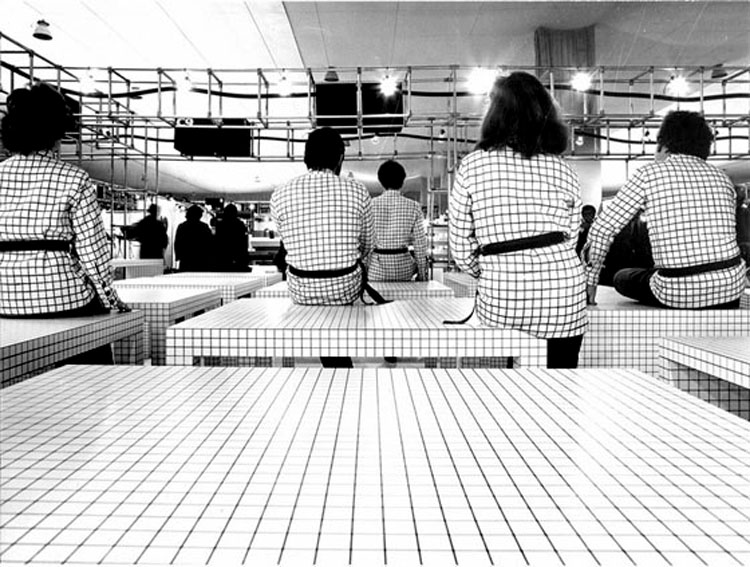
Architecture, once considered the most complete and noble of the arts, has lost its pre-eminence not only because of the external difficulties of a political and economic nature that it has always encountered, but also because of a deep internal crisis now afflicting it as a result of modifications in the mechanisms of cultural production and of the urban function itself.
Today the city is becoming more and more a structure offering services, a place merely to live in ; it is no longer one of society's cultural structures. The communication carried out by architecture, based on the allegory of balances between man and his natural environment, is motionless in space and lacking in the depth of psychic penetration that the electronic media have achieved. Today the city is no longer a cultural " place" but a "condition". Urban culture,
in other words, is independent of the city as a place and it coincides with the culture of consumption.
To be an urbanite today does not mean to live in a city but to adopt a specific model of behaviour made up of a certain way of speaking, of printed and televised information, of a particular kind of clothing, of the music one listens to: wherever these media arrive, the city arrives. There is no longer any culture external to the urban phenomenon in as much as there is no longer any countryside representing a real and logical alternative; there is no place which does not to some extent communicate with the city and Its models. The "urban condition" coincides with the social circulation of goods, which can be exported from any metropolitan area. Every day millions of cubic metres of this new type of city are produced, and every day millions of cubic metres of city become rubbish, in keeping with the laws of a metabolism unknown to the immoveable equilibria of the city.
The concept of culture itself is changing. Until quite recently produced by a small group of intellectual professionals and consumed by a numberless mass of readers, visitors, subscribers, enthusiasts and voyeurs who had only to buy the book, disc or ticket, and were institutionally excluded from any right to produce or consume a private culture as anatural right (since culture is a higher and "universal" good, to produce which one must undergo a stressful series of exercises, tests, studies, examinations, consultation, and dedicate his life to it), culture, as I was saying, is now experienced as an immediate, spontaneous good, the direct product of a certain social behaviour and a model of consumption, an economic stimulus. What we are witnessing here is the reversal of the traditional hierarchies; more importance is attributed to the window dresser, decorator, fashion designer, expert in colours, upholsterer, opinion leader, taster, make-up expert, etc. than to the "artist" intent on sending out allegorical messages to the world.
Architectonic quality is much less important than the quality of the microclimate one experiences inside, and good acoustics are preferred to observance of the laws of composition ...
Architecture now becomes a "minor art" applied to the harmonious resolution of functional and structural problems and kept outside the real circuits determining the" quality of life" and culture.
The masterwork of architecture ended not only when culture became an article of consumption but when the profession definitely took the place of the art; as long as the schools of architecture were clubs for a few enthusiasts, methodological planning opened large areas of "creative" variations; but now that architectonic planning has to be taught to thousands of people, it is idle to think of introducing unknown quantities of any kind. The number of unknown factors that architectonic planning is called on to resolve today has been reduced almost to zero. Variation in design consists of a simple compositional scheme often chosen at random without regard for different cultural areas, but only for the availability of elements differentiated on the industrial plane alone. Pasolinl claims that there are no longer any somatic differences between youths of the left and the right. It is also true that there are no ideologies capable of producing different results in the architectonic idiom. The long Italian battle fought against construction surveyors, responsible for the low cultural level of much urban architecture, is the result of a mistake rooted in the certainty long cultivated by the Modern Movement that there Is an indivisible identity between urban quality and civilization. The quality that we ask of the city today has nothing to do with form or composition, but only with the quality of social services and the market. For architects the time hascome for a bit of modesty ...

Radical Notes, 1975