26.8.12


RUSSIAN CYCLE
Pre-Soviet Period, Suprematism & other mysterious CCCP movements

I was deriving, a few days ago, on Tverskaya's Moscow main avenue and I found in the basement of a mainstream bookshop some architectural publications about the pre-soviet period, suprematism and brochures from different CCCP time. Everything is unfortunately written in russian but it adds something really mysterious -  don't know what is it, student work perhaps - but something really powerfull cames from all that people's faces who seems totally engaged in their tasks, to produce with high belief all these abstract architectural models and drawings. 
In a way, it also reveals what you can feel when you're in Russia from a quiet short time, you cannot really understand what's happened here - language people reactions - even if everything looks the same everything is different ;  something which can be contain in this Dostoievsky's quote " Russians are not whites, blacks or yellows, they are greens". It will follow a posts' series about that feeling and stuffs I found here and there.


15.7.12


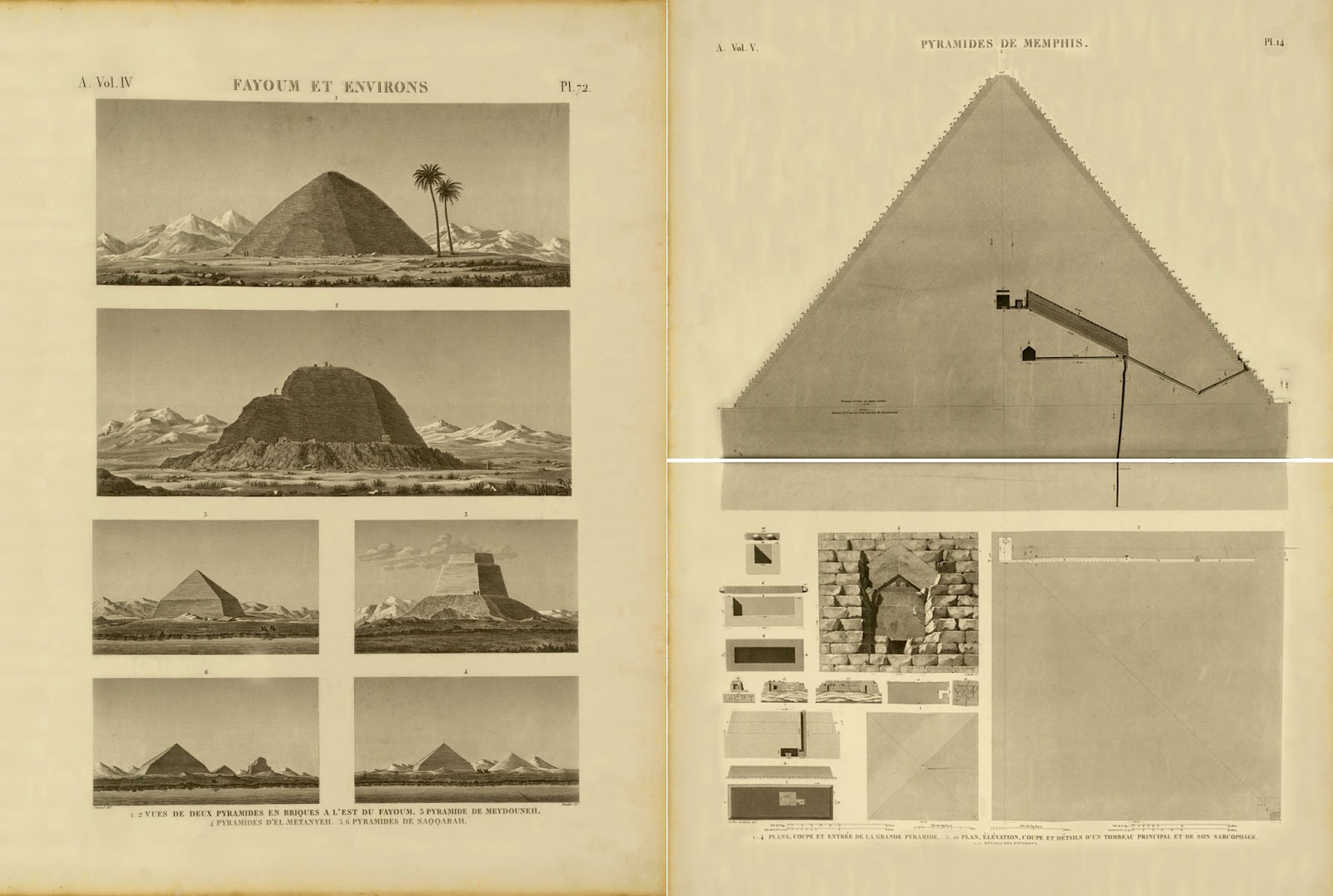
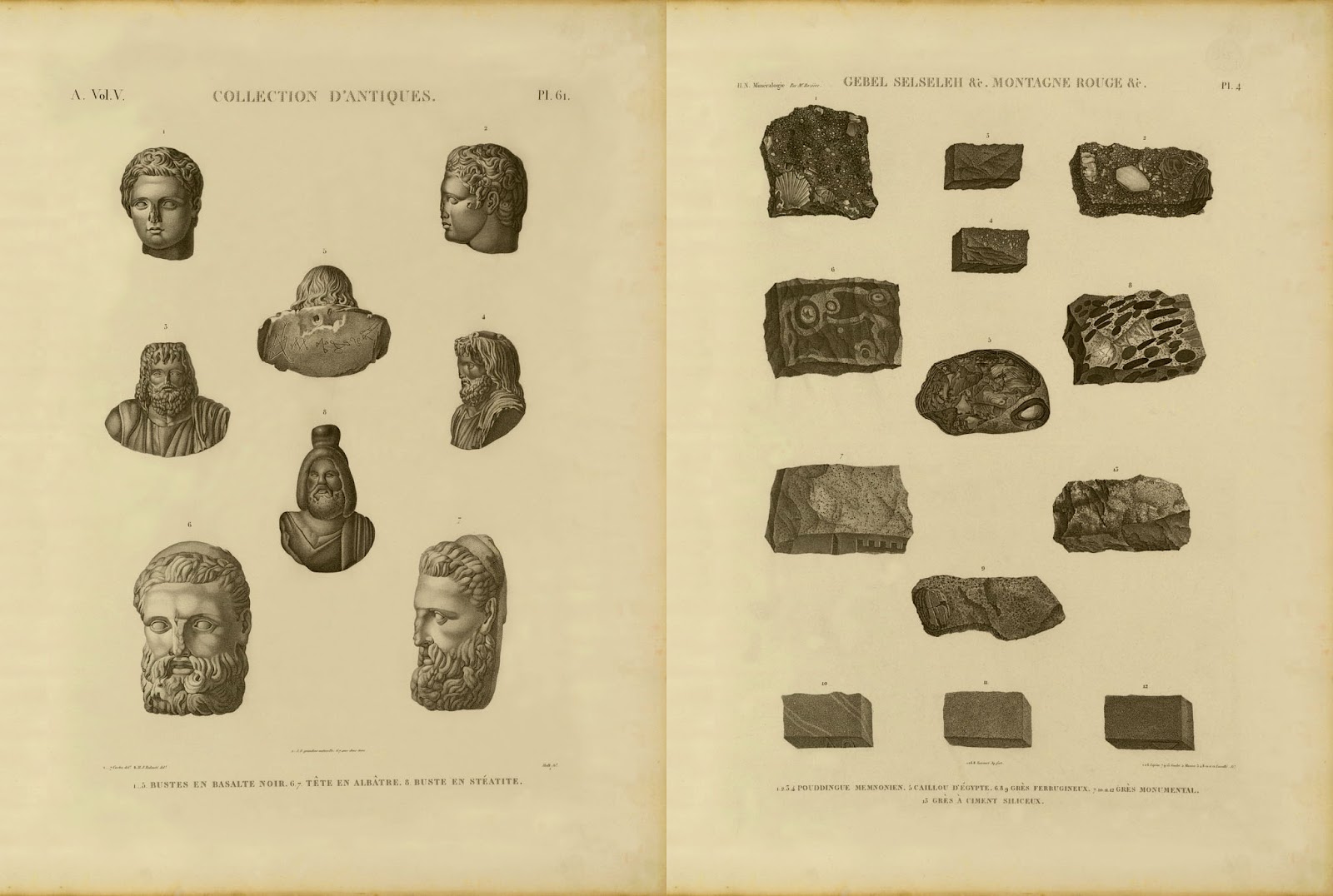
LA DESCRIPTION DE L'EGYPTE 
Napoléon Bonaparte & 500 others


"Soldiers, from the height of these pyramids, forty centuries look down on you.." thus Napoleon is said to have addressed his troops shortly before the battle of the pyramids (17 july, 1798 ). His words aptly summarize the result of the "Egyptian campaign", a military disaster which had an extraordinary consequences for archeology.
One must be mad as only the french can be to send one's best army and on's best general to the ends of the earth when the homeland itself is under multiple attack. The ostensible motive was a generous one : to free the egyptian people from the Ottoman Empire and its Mamelukes. The real motives was to found a French colony and make Egypt a province of the Republic, thus reinforcing French domination in the Mediterranean basin and even, perhaps, extending it into Asia. Napoleon dreamt of Alexander and Caesar and wished to emulate their glory. Intended to wound the soft underbelly of the English, the campaign was an abject failure. At Abukir, Nelson sank 200 ships which had conveyed the expeditionary force and the French army found itself a prisoner of its conquest. Napoleon abandoned his army, returning with all speed to France to defend his country against the Coalition and to have himself crowned Emperor.

The expedition was a military and political fiasco - and it changed the face of the earth : by revealing the splendor of a mysterious and forgotten civilization, it gave birth to Egyptology. The cultural and scientific elite of France accompanied the expeditionaty force. Was Napoleon seeking justification for its conquest? Or was this simply the cultural heritage of the Enlightenment? Whatever his motives, 500 civilians accompanied the army, amongst them a group of 167 scholars that included 21 mathematicians, 3 astronomers, 17 civil engineers, 13 naturalists, 4 architects, 8 draughtsmen, 10 men of letters, 22 printers equipped with Latin, Greek and Arabic characters.
Napoleon's artillery destroyed the furious charges of 10,000 Mamalukes cavalry beneath the pyramids of Giza; then, as soon as he had seized Embabeh, forcing routed Mamelukes to scatter into the Nubian desert, the scholars went to work. For the greater gloty of the French Republic, they were to find, beneath the millennial sands, the vestiges of Pharaonic Egypt, the "cradle of the science and art of all humanity " as Napoleon put it. A commission of Science and Art and an Egyptian Institute were promptly founded. Under their guidance, everything was systematically catalogued and meticulously drawn, from the monolithic obelisks with their rich decoration to the vast statues that dominated the palm-trees of the Nile Banks.
All was completed in 23 volumes...


28.6.12


BLADE RUNNER AQUARELLE EDITION
Anders Ramsell


Blade Runner's Ridley Scott's masterpiece is reinterpreting here by the swedish artist Anders Ramsell ( also from The Creatos Project ) who spent eleven months and 3 585 aquarelles to produce 13 minutes of films (see here) . His aim right now is to make the entire movie, which will correspond to 32 300 paintings.


More about paintings herethere
And about reinterpreted stories with Christian Patterson photographic book on Terence Malick Badlands

10.6.12


X-URBANISM
Mario Gandelsonas

Studies on the american grids, how to speak about cities, through their radical substances.


Los Angeles
The uniquely American one-mile grid, the relentless continental grid that organizes the megalopolis, is seen in contrast to the urban grids and the boulevards


Boston - The Head and the neck
Alternating sector of urban fabric and fields - with or without building objects - form the head of Boston. The neck, can seen as the result of the overlapping of different grids. Interventions made after World War II have deeply affected the morphology of Boston, erasing entire areas of the close-knit fabrid of the seventeenth and eighteenth centuries and replacing them with Modernist-inspired building developments.
The result is a series of discontinuous radical sectors of fabric alternating with sectors of objects in a field revealed by the analytical drawings. The peculiar topographic history of Boston (the leving of hills and the filling of Back Bay ) might partially explain the different degrees of resistance to change that characterize the historical fabric of Beacon Hill, for instance.


New Heaven
The original plan of New Heaven contained elements that should both insure the survival of the original grid - an oversized nine-square grid (825 total square feet) with a common green in the center - while also generating a new order for its development, several diagonal streets leading outward from the core. The radial field system surrounding the nine-square grid persists in the plan of New Heaven today. However, this description represents only a simple, perceptual understanding of the city.

Chicago
While the neutral geometric grid and the regular "beat" of intersections in the city of Chicago imply continuous movement, the accidents of the plan produce changing rythms and interruptions where movement stops.
The Ink drawings
he series of ink drawings examine two situations that produce these interruptions of the one-mile grid : the effect of the multiple diagonals that crisscross the plan, and the effect of topographic changes.


 and more about La Grille here